China Business Limited

Radioactive Contamination in the Supply Chain: The 2025 Cesium-137 Crisis
Since August 2025, the global food supply chain has faced a critical disruption involving radioactive Cesium-137 (Cs-137) contamination in exports from Indonesia. The contamination, originally linked to frozen shrimp, has now spread to spices, specifically cloves, triggering severe regulatory countermeasures by the U.S. FDA. This alert affects all importers and industrial users sourcing from the Island of Java and Lampung Province (Sumatra). Effective October 31, 2025, strict import certification is mandatory. Failure to comply will result in automatic detention of goods.
QUALITY CONTROLFOOD SAFETYREGULATIONS
6/18/20253 min read

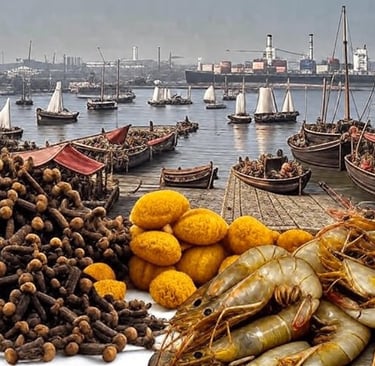
1. The Trigger Event: Anatomy of the Contamination
The crisis escalated rapidly following two distinct detection events that signalled a systemic environmental issue rather than isolated incidents.
· The Spice Consignment:
o Product: Cloves (Whole fruit/stems).
o Exporter: PT Natural Java Spice (Indonesia).
o Contamination Level: FDA laboratory analysis confirmed 732.43 Bq/kg of Cesium-137 in one screening sample. While this is below the strict intervention limit of some nations (often 1,200 Bq/kg), the presence of any artificial radionuclides in spices indicates a serious breach of GMP (Good Manufacturing Practices).
o Outcome: The firm was immediately placed on Import Alert 99-51 (Detention Without Physical Examination).
· The Shrimp Connection:
o Scale: Over 58 million pounds of shrimp were associated with recalls or alerts involving Indonesian exporter PT Bahari Makmur Sejati (BMS Foods).
Linkage: The FDA established a correlation between the contaminated shrimp and the spices, suggesting a shared environmental source of radioactivity in specific industrial zones
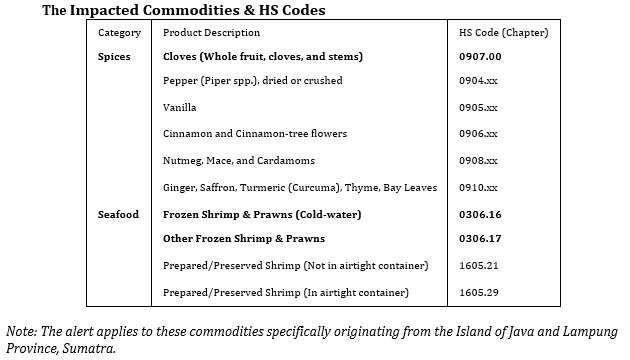
2. Affected Products and HS Codes
The FDA’s Import Alert 99-52 is broad, covering all shrimp and all spices from the specified regions. Supply chain managers should flag the following Harmonized System (HS) codes in their ERP systems immediately:
Notice any errors? Please help us rectify to get free sample!
Disclaimer: This blog is for informational purposes only and does not constitute legal advice. Regulations change rapidly; always consult the official FDA Import Alert database for real-time updates.
White Label / Private Label Services
Welcome White Label / Private Label inquiries with full customization, control over Quality/Safety, and ensuring excellence in processing, packaging, and exporting of products.
3. Regulatory Framework & Notifications
Businesses must adhere to the new requirements established under the Food Safety Modernization Act (FSMA) Section 801(q).
· Import Alert 99-52 (Certification Requirement):
o Effective Date: October 31, 2025.
o Requirement: Shipments leaving Indonesia on or after this date must be accompanied by an Import Certificate issued by a designated certification entity recognized by the FDA.
o Scope: Applies to all spice and shrimp shipments from the affected regions, regardless of the specific exporter’s history.
· Import Alert 99-51 (Detention Without Physical Examination):
o Scope: Targets specific firms (e.g., PT Natural Java Spice) found to have shipped contaminated goods.
o Consequence: Shipments are detained automatically at the U.S. port of entry. Release requires the importer to prove (via private lab testing) that the specific lot is clean—a costly and time-consuming process.
4. Probable Sources of Contamination
Investigations by Indonesian authorities and international watchdogs have pointed to industrial negligence rather than nuclear power accidents.
· The "Lost Source" Theory:
The epicenter of the shrimp contamination has been traced to the Cikande Industrial Estate (West Java). Reports identify a steel manufacturer, Peter Metal Technology, which utilizes imported scrap metal. It is suspected that a radioactive source (such as a discarded industrial density gauge or medical device containing Cs-137) was accidentally melted down with scrap metal.
· Environmental Fallout:
This melting process likely released radioactive particles into the facility’s waste stream and ventilation system, settling on the nearby BMS Foods shrimp packaging facility located just 2km away.
· The Spice Link:
A clove farm in Lampung Province (Sumatra) was subsequently found with trace radioactivity. Authorities are investigating if this is due to similar industrial waste dumping or cross-contamination via contaminated shipping containers used for exports.
5. Risk Analysis
For Consumers (Health Risks)
· Bioaccumulation: Cesium-137 mimics potassium biologically. If consumed, it is absorbed into soft tissues and muscles.
· Long-term Impact: While immediate radiation sickness is unlikely at 732 Bq/kg, chronic consumption increases the cumulative dose, raising the statistical risk of solid tumours and cancer over years.
For Industry (Business Risks)
· Demurrage & Detention: Cargo without the correct certificate will be held at the port. Daily demurrage charges can exceed the value of the cargo within weeks.
· Recall Liability: If Cs-137 is detected post-distribution, the cost of a Class I or Class II recall (notification, reverse logistics, destruction) falls on the importer of record.
· Brand Damage: Association with "radioactive food" can permanently damage brand equity for distributors and catering firms.
6. Action Plan for Industry Players
Exporters (Indonesia):
· Secure contracts with FDA-recognized certification bodies immediately.
· Conduct pre-export screening for Cs-137 on every container using portable gamma spectrometers.
Importers & Distributors:
· Update Contracts: Amend purchase orders to require "FDA Import Certificate per IA 99-52" as a condition of payment.
· Verify Origin: scrutinize Bills of Lading. If the "Port of Loading" or "Place of Receipt" is in Java or Lampung, demand proof of testing.
· Insurance: Check if your Marine Cargo Insurance covers "rejection insurance" or losses due to radioactive contamination (often a standard exclusion).
Industrial Users & Caterers:
· Audit Inventory: Check lot numbers of cloves, nutmeg, and shrimp received since August 2025.
· Demand Transparency: Request a Letter of Guarantee from suppliers confirming their products do not originate from the restricted zones or have passed radiometric testing.
Tel: +852 25172316
© 2024. All rights reserved. All information on this site is without any contractual, financial or otherwise any other liability. Services provided on a per-transaction basis. No retainer or ongoing engagement. For binding information, please contact us and include your concerns or requirements in enquiry, quotation, contract and shipping documents.
Hong Kong.
Fax: +852 25178741
China Business Limited
5/Fl., Qualipak Tower, 122 Connaught Road West
Hong Kong